I Pray All Is Well With Everyone… And Your Hearts And Minds Are Full Of Love, Joy, And Compassion… For All God’s Children…And All God’s Creation. And For Those Of Us Who Know That There Is Forever A Sanctuary Of Love Within Ourselves; And That Love Is Our Life Stream – Our “Mighty I AM Presence…Let Us, Then, Draw From That Never-Ending Well Of Love – Our Essence; That Power of The Living God That Dwells Within Us – Our Loving Energy; By Leading With Love In All Our Thoughts And Actions. And This Collective Effort Will Steadily Raise The Vibration Of All Humanity …To The Heights Where Love Is Always First – And Always Active! Amen…

Give Thanks And Praises For Love And Life…

And Y’all Be Love…
“The line that separates magic from religion is exceedingly tenuous, and the magician is never loath to step across it to appropriate, for his own purposes purely religious objects and beliefs. Or perhaps I should put it the other way ’round – certain religious elements acquire in time an aura of sacredness and power which clothes them, in the eyes of superstitious people, with magical properties, and they thus offer themselves spontaneously to the sorcerer. In practice, the process involves not so much a deliberate act of appropriation on the part of the magician, who is himself a member of the religious group, as it does a utilization of those tools that lie at hand. Superstitious beliefs must exist in the mind of the people before it can be put to magical use. We have seen how the spirits, and even God, came to serve the magician. But the best illustration of this process is the rôle which sacred Scriptures play in magic the world over.
Today we may treasure Bibles for the profound religious and moral truths they reveal; historically, however, their virtue has consisted primarily in their divine origin. Scripture is sacred not only for the wisdom it teaches, but even more for its close association with the person of the deity who revealed it. It speaks in the voice of God, and therefore, says more than one who runs may read. It possesses something of the personality and attributes of deity, and so there grow up, schools of mystical and esoteric exegesis which profess to discover the hidden inner significance of the Word. And it is more than it appears to be: not only is it the word of the Lord, it is the Lord himself, an emanation from His being, a particle of His Essence.
God has revealed Himself to man, and by so doing, has in a measure placed Himself within man’s reach, to be aspired to as Ideal, to be prostituted as Power. Many men have searched earnestly and devoutly in Scripture for a vision of eternal truth. But many, many more have been content to capitalize Scripture for professional ends. Priest and magician, and the credulous masses upon whom they imposed, have been equally guilty of using the word of God for personal profit and power.
The Vedas among the Hindus, the Avesta, and the Tao-Teh-King, Homer at the hand of the Greeks, the Old and New Testaments in Christian lands, the Koran in Mohammedan – for some men they have been storehouses of wisdom; for the masses, to whom through many centuries their contents were directly unknowable, they have been rather sacred works regarded as much with superstitious awe as with reverence, used as often for magical as for religious ends. Illiteracy, an obscurantist clergy which sought to make these books its private property, the position of the books in the ritual, often itself semi-magical, the mystical haze thrown around them, and, most of all, the superstitious credulity of the people, these factors combined to make of such scriptures, tools in the hand of the magician as well as of the priest.
The Bible, though perhaps better known to the Jewish masses in post-Biblical times than these other works have been to their own peoples, was similarly impressed into magical service. The very intensity of Jewish study of the Bible, and the centrality in Judaism of the doctrine of direct revelation, facilitated the subjection of this book to the fate of the others. It was drawn upon extensively for the formation of the cryptic names which constituted the heart of magical activity. In its totality, as well as in its major and minor divisions, its books and chapters and verses, it was directly employed in the magical science.
The Sefer Torah, the Scroll of the Torah, was a holy object, which must be treated with respect and veneration. A body of rules was developed regulating one’s conduct in its presence: one must not lean on it, place anything upon it, touch it with unclean hands, kiss it immediately after kissing wife or child, have intercourse in its presence; admonitions which perhaps indicate also a measure of fear of the power of the book to retaliate and punish disrespect, a vestige of ancient taboo. But when an infant was ill and could not sleep, or a woman was convulsed in labor pains, the Scroll was brought in and laid upon the sufferer to alleviate the pain. Of course the religionists clamored against such impiety; some were willing to permit such practices only in case a life was in danger; others permitted the Scroll to be brought only to the entrance of the chamber in which a parturient woman lay “that the merit of the Torah may protect her,” but not as a magical healing-device – and by such concessions acquiesced in popular superstition.
Some there were who forbade these practices altogether: “It is not enough to brand people who do this as sorcerers and conjurers; they pervert the fundamental principle of Torah in making it a healing for the body when it is intended only for a healing of the soul.” But such voices did not carry far. The curious womb-exhortation illustrates the popular attitude toward the Bible: “Baermutter [womb] lie down! With these words I adjure thee, with nine Torahs, with nine pure Sefer Torahs!”
The report that the book of Leviticus was placed under the head of an infant in its cradle is too reminiscent of the above-mentioned use of the Torah, and of the prescription of a Latin physician of the third century that the fourth book of Homer’s Iliad be placed under a patient’s head to cure him of the quartan ague, to credit the explanation that this was done solely because the child’s education would commence with a study of Leviticus. The Kabbalists made quite a to-do over certain portions of the Pentateuch to which they attributed a very deep mystical significance.
Whoever reads the chapter about the manna (Exodus 16) daily, will be insured against lack of food; a daily perusal of the verses which describe the composition of the incense (Exodus 30:34-38), with proper concentration on their esoteric meaning; “if people knew how important these verses are, they would cherish each letter as though it were a crown of gold upon their head”, protects man against magic and evil spirits and plagues, even postpones death by off the attack of the Angel of Death. Most efficacious of all, in this respect, were the portions of the Torah which describe the sacrificial offerings; regular study of them in their mystical sense, which constitutes an effective substitute for the actual sacrifices, produces wondrous rewards.
The words of holy writ were the most potent charms against the forces of evil. Upon all critical occasions, when spirit attacks were feared, such as prior to a funeral, or the night before circumcision (the Wachnacht), or indeed all the eight nights after birth, or the nights of holydays which are momentous for the fate of the individual, such as Yom Kippur and Hoshana Rabbah, studying the Bible and other holy writings was a common prophylactic. “As soon as a man has ceased his preoccupation with the words of Torah, Satan has permission to attack”; this was the general principle.’ The use of “words of Torah” for specific magical purposes goes back to a hoary antiquity. The injunction of Deuteronomy 6:9, “And thou shalt write them upon the doorposts of thy house and upon thy gates”, whether originally meant altogether literally or not, was so understood, and the mezuzah from earliest times until today has been looked upon as an amulet to protect the home against demons.
The utility of Biblical verses as charms was not unknown in the Talmudic period. If one dreamt of a stream, he was advised to recite Isaiah 66:12, “I will extend peace to her like a river”, immediately upon waking, lest the words “distress will come in like a flood” (Isaiah 59:19), occur to him first; Psalm 29:3-10, containing seven references to “the voice of God,” was suggested to protect one who must drink water on a night when the evil spirits are particularly active; the words of Numbers 23:22-23, beginning with “El” (God) and ending with “El,” ward off the ill effect that results from a dog or a woman passing between two men.
A sixteenth-century authority, R. Ḥayim B. Beẓalel, attempted to negate the obvious sense of such devices: “The Talmud advises us,” he wrote, “that when a man recites the sentences beginning and ending with ‘El’ he cannot be harmed by any enchantment or sorcery; the point of this is that the man who believes wholeheartedly that God is first and last, and besides Him there is no other god, is certainly impervious to such harm.” With due deference to the worthy and pious intention of this writer, the point is that the mere recital of these words has the indicated effect. In Talmudic times Biblical verses were often employed to heal wounds and diseases, despite rabbinic opposition to this practice. Even stronger was the prohibition against expectorating in the course of such a charm; spitting is a universally recognized magical act, and the authorities sought at least to eliminate this most objectionable feature; it was an act of irreverence unworthy of the Jew, they explained, avoiding the true reason. In later centuries this prohibition was drawn to a fine point, to get around its common transgression. It was limited to those verses in which the name of God occurs, and further “this is forbidden only when the verse is recited after expectorating, for it makes it appear that the name of God has been coupled with that act, and only when the charm is couched in Hebrew. If the name of God is uttered in another tongue, this prohibition does not apply at all.”
Even the effort to prevent such practices on the Sabbath was unsuccessful. Human need overrode the law, and in cases of serious illness the rabbis consented to be deaf and blind. In such matters law beats futilely against the iron wall of mass will; official Judaism was obliged to bow to popular superstition and accept practices which it would gladly have seen destroyed. These concessions are a tribute to the deep-rooted persistence of superstitious ways of thought and action.”
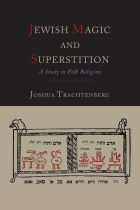
Jewish Magic and Superstition, by Joshua Trachtenberg, 1939
Music: Voices – Patrick Patrikios
 The Mark Of God: Understanding Your "I AM Presence"